Key Takeaway
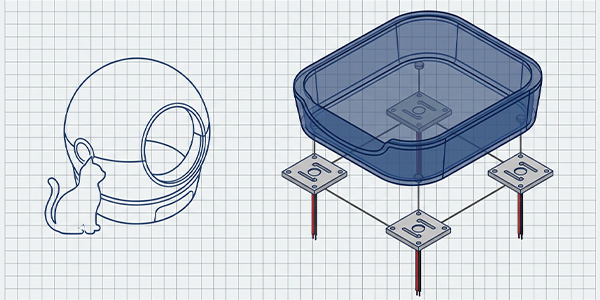
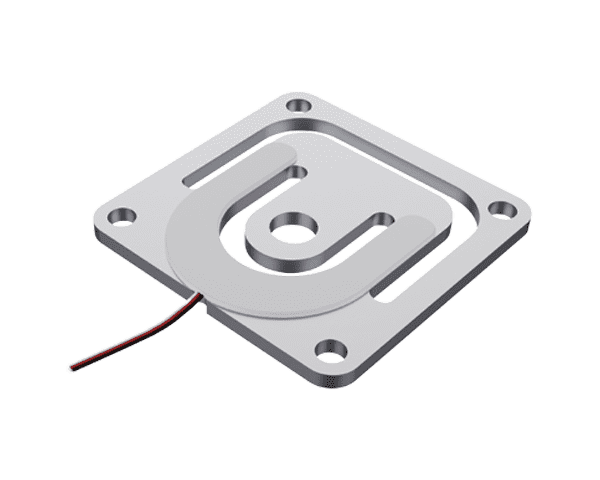
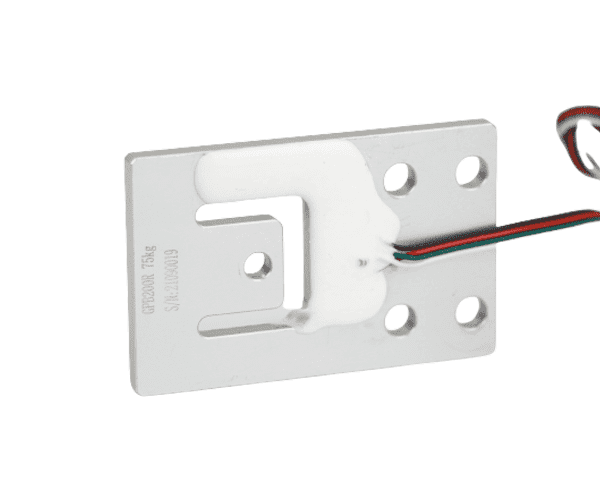
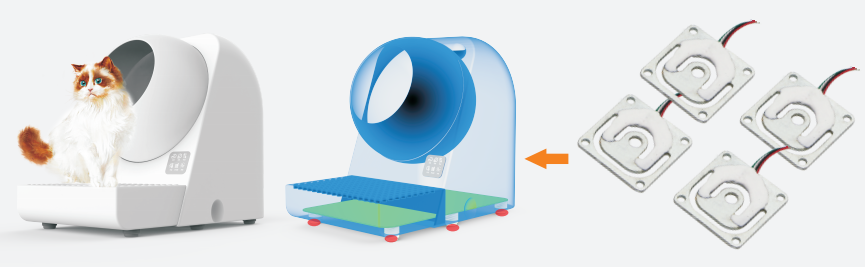
Smart cat litter boxes use GML670 micro load cells (4 × half-bridge, 50kg each) installed at the four corners to monitor cat weight, track litter usage, and trigger automated cleaning — all without disturbing your cat. With ±0.05% F.S. precision and a ultra-thin 2.5mm profile, GML670 is the industry standard for smart pet IoT devices.
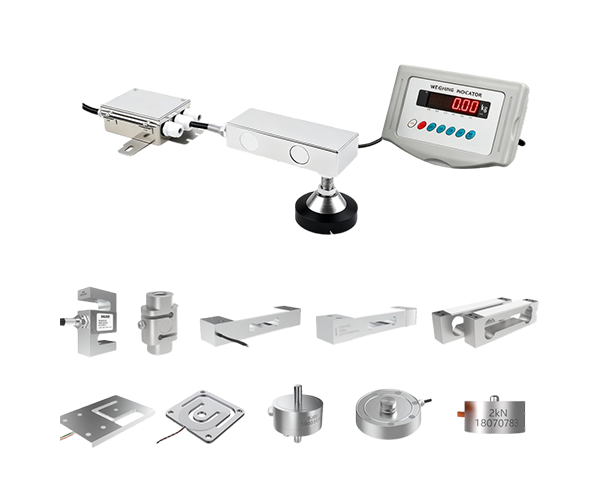
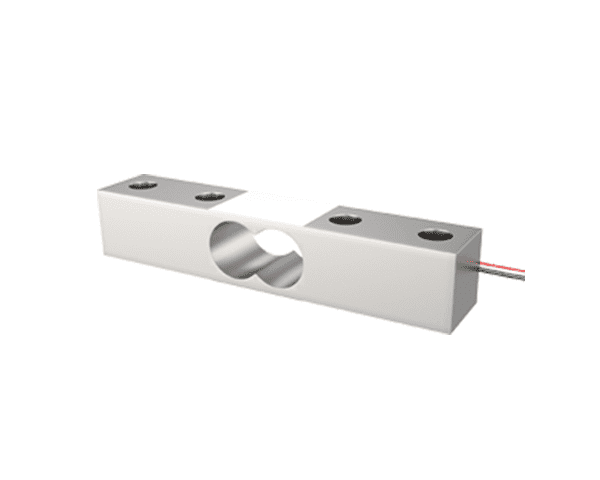
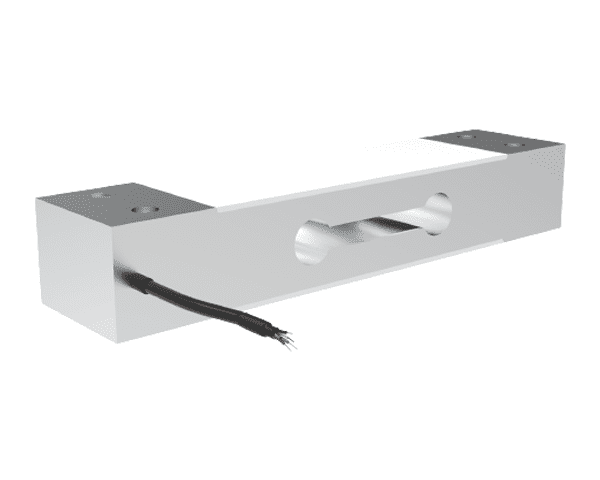
Recommended models: GML670 (★ Best Seller) · GML670A · GML671 · GML692 · GML695
Smart cat litter boxes have revolutionized pet care by automating waste management while quietly monitoring feline health. At the heart of these devices lies a precision micro load cell — a sensor so small yet so accurate that it can detect a 1.5 kg kitten stepping in while ignoring the 30 kg litter box itself. This guide explores how load cells power smart litter box monitoring systems, how to select the right sensor, and why the GML670 has become the go-to choice for leading pet-tech brands worldwide.
What Is a Cat Litter Box and How It Has Evolved
A cat litter box is a designated bathroom area for cats, filled with special litter that absorbs moisture and controls odors. Cats, originally from desert environments, bury their waste in sand to hide from predators — a natural instinct that evolved into the household litter box habit we know today. A well-sized litter box gives cats enough room to move and dig, directly impacting their comfort and willingness to use it.
The evolution from traditional trays to smart cat litter boxes represents one of the most significant leaps in pet-care technology. Here's why smart models are a game-changer:
-
Hands-free cleaning: Automatically scoops or filters waste, reducing manual maintenance to once every 1-2 weeks.
-
Odor control: Built-in UV sterilization, activated carbon filters, and sealed waste compartments keep homes fresh.
-
Health monitoring: Integrated load cells track cat weight and bathroom frequency, alerting owners to potential health issues early.
-
Smart notifications: Mobile apps send real-time alerts for litter level, waste bin fullness, and abnormal usage patterns.
-
Multi-cat identification: Advanced models use weight profiles to distinguish individual cats and track each one's habits separately.
-
Time-saving: Automated maintenance gives owners more quality time with their pets instead of cleaning.
How Does a Smart Cat Litter Box Work?
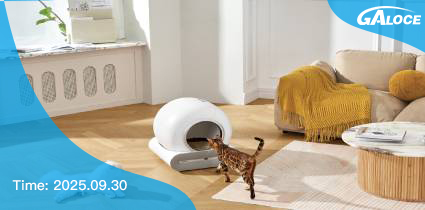
A smart cat litter box automates waste management through a rotation-and-filtration mechanism. You pour cat litter into the cabin; after your cat uses it, the litter forms clumps. The box then rotates like a cement mixer, filtering out clumped waste through an opening into a sealed compartment below, while clean litter stays for reuse. The entire cycle takes 60-90 seconds and is triggered automatically when the cat exits.
The critical safety feature is the load cell-based entry/exit detection. When the sensor detects weight on the platform, the rotation mechanism is locked — preventing any movement while the cat is inside. Once the cat leaves and a preset delay (typically 3-7 minutes) passes, the cleaning cycle begins. This is why choosing the right load cell is essential for both safety and functionality.
Key Components of a Smart Litter Box System
|
Component
|
Function
|
Specification
|
|
Load Cell (×4)
|
Weight detection, cat entry/exit, litter level
|
GML670 half-bridge, 50kg each, ±0.05% F.S.
|
|
HX711 ADC Module
|
24-bit signal conversion from load cell
|
24-bit ΔΣ ADC, up to 80 SPS
|
|
MCU Controller
|
Process weight data, control rotation motor
|
ESP32 / STM32, Wi-Fi + BLE
|
|
Rotation Motor
|
Drum rotation for litter sifting
|
12V DC gear motor, 180° rotation
|
|
Odor Control
|
UV sterilization + activated carbon filter
|
254nm UV-C lamp, carbon filter cartridge
|
|
Mobile App
|
Remote monitoring, alerts, health reports
|
iOS/Android, cloud sync, push notifications
|
The Role of Load Cells in Smart Litter Boxes
The load cell is the single most critical sensor in a smart litter box. It performs three essential functions simultaneously:
1. Cat Entry/Exit Detection & Safety Lock
The load cell continuously monitors platform weight. When weight exceeds a threshold (typically 0.5-1 kg above baseline litter weight), the system detects a cat has entered and immediately locks the rotation mechanism. This prevents the drum from rotating while the cat is inside — a critical safety feature. After the cat exits and weight returns to baseline, a configurable delay timer (3-7 minutes) begins before the cleaning cycle starts.
2. Cat Weight & Health Monitoring
Each time the cat uses the litter box, the load cell records its weight. Over time, this data builds a weight trend chart that can reveal:
|
Weight Pattern
|
Possible Health Signal
|
Recommended Action
|
|
Steady gradual gain
|
Normal growth (kitten) or overfeeding
|
Monitor food intake, adjust portions
|
|
Sudden weight loss (>5%)
|
Dehydration, illness, dental issues
|
Vet visit within 48 hours
|
|
Weight plateau
|
Adult maintenance or hidden obesity
|
Compare with BCS chart, adjust diet
|
|
Frequent small fluctuations
|
Normal hydration/food cycle
|
No action needed — healthy pattern
|
|
No weight detected for 24h+
|
Cat not eating or using litter box
|
Urgent — check cat's location and health
|
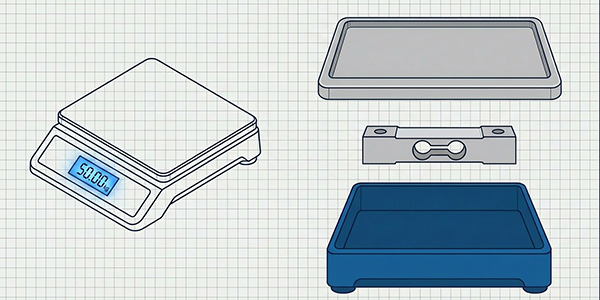
3. Litter Level Monitoring
The load cell measures the total weight of the litter box assembly (box + litter + waste). By subtracting the known empty-box weight, the system calculates remaining litter quantity. When litter falls below a preset threshold, the app sends a "low litter" notification. Similarly, as the waste compartment fills, the increasing weight triggers a "time to empty waste bin" alert — typically every 7-12 days depending on cat count.
Why Micro Load Cells Are Ideal for Smart Litter Boxes
Smart litter boxes demand sensors that are compact, precise, and cost-effective. Standard industrial load cells are simply too large and too expensive for consumer pet products. Micro load cells like the GML670 series solve this challenge with several key advantages:
|
Advantage
|
Why It Matters for Litter Boxes
|
GML670 Spec
|
|
Ultra-Thin Profile
|
Fits inside the slim base of modern litter boxes without adding bulk
|
2.5mm thickness
|
|
Half-Bridge Design
|
4-corner parallel wiring averages the load, compensating for off-center placement
|
3-wire, 4 pieces per set
|
|
Manganese Steel
|
Superior fatigue resistance for millions of cat entry/exit cycles
|
Premium Mn-Steel alloy
|
|
High Precision
|
Detects 10g-level changes for accurate kitten weighing and litter tracking
|
±0.05% F.S.
|
|
Cost-Effective
|
Half-bridge design uses fewer strain gauges, reducing BOM cost
|
3-wire vs 4-wire full bridge
|
|
Compact Footprint
|
34×34mm fits in tight mechanical designs under the litter drum
|
34×34×2.5mm
|
Half-Bridge vs Full-Bridge: Which to Choose?
The GML670 series offers both configurations. Understanding the difference is crucial for litter box design:
|
Parameter
|
GML670 (Full Bridge)
|
GML670 (Half Bridge)
|
|
Wires
|
4-wire (E+, E-, S+, S-)
|
3-wire (E+, E-, Signal)
|
|
Strain Gauges
|
4 (full Wheatstone bridge)
|
2 (half Wheatstone bridge)
|
|
Precision
|
±0.05% F.S.
|
±0.05% F.S. (matched set)
|
|
4-Corner Output
|
Single sensor usable
|
4 pieces = total range × 4, sensitivity × 2
|
|
Cost
|
Higher (4 gauges per unit)
|
Lower (2 gauges per unit)
|
|
Best For
|
Single-sensor precision applications
|
Smart litter boxes (4-corner, cost-optimized)
|
For smart litter boxes, the half-bridge configuration (4 pieces per set) is strongly recommended. It delivers the same ±0.05% accuracy at roughly half the cost per sensor, and the 4-corner parallel wiring naturally compensates for off-center loads — a cat rarely stands in the exact center of the litter box.
Recommended Load Cells for Smart Cat Litter Boxes
Typical smart cat litter boxes weigh 15-30 kg empty, cats weigh 1.5-8 kg, and cat litter adds 1-5 kg — bringing total system weight to approximately 50 kg. This makes 50 kg capacity micro load cells the standard choice. When installed as a 4-corner half-bridge set, the total range becomes 200 kg (50 kg × 4), providing ample headroom for large cats and full litter loads.
GALOCE offers five micro load cell models optimized for smart litter box applications:
|
Model
|
Capacity
|
Accuracy
|
Size (mm)
|
Sensitivity
|
Cable
|
Configuration
|
|
GML670 ★
|
50 kg
|
±0.05% F.S.
|
34×34×2.5
|
0.9±0.1 mV/V
|
φ0.8×450mm
|
Half bridge, 4 pieces/set
|
|
GML670A
|
50 kg
|
±0.05% F.S.
|
34×34×2.5
|
0.9±0.1 mV/V
|
φ0.8×450mm
|
Half bridge, 4 pieces/set
|
|
GML671
|
50 kg
|
±0.3% F.S.
|
30×25×2.5
|
1.2±0.15 mV/V
|
φ0.8×450mm
|
Half bridge, 4 pieces/set
|
|
GML692
|
50 kg
|
±0.2% F.S.
|
34×34×7.8
|
1.0±0.15 mV/V
|
φ0.8×450mm
|
Half bridge, 4 pieces/set
|
|
GML695
|
50 kg
|
±0.2% F.S.
|
28×24×6
|
1.0±0.15 mV/V
|
φ0.8×450mm
|
Half bridge, 4 pieces/set
|
Note: All models use half-bridge configuration with 4 pieces per set. Total range = single range × 4. Total output sensitivity = single sensitivity × 2.
GML670 — Industry Standard for Smart Litter Boxes ★
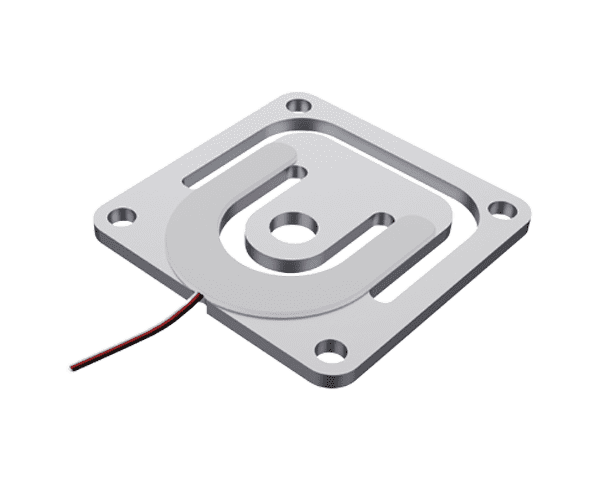
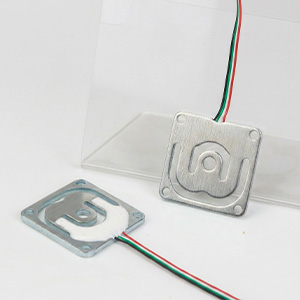
The GML670 is GALOCE's best-selling micro load cell, purpose-built for space-constrained IoT applications including smart litter boxes, body fat scales, and retail shelves. Its manganese steel construction delivers exceptional fatigue resistance, while the ultra-thin 2.5mm profile integrates seamlessly into modern litter box base designs.
|
Rated Capacity
|
5-200 kg (Half bridge: 10-75 kg)
|
|
Accuracy
|
±0.05% F.S.
|
|
Sensitivity
|
0.9±0.1 mV/V
|
|
Dimensions
|
34×34×(1.0~4.0) mm
|
|
Material
|
Manganese Steel
|
|
Bridge Type
|
Full Bridge (4-wire) / Half Bridge (3-wire)
|
|
Cable
|
φ0.8×450mm
|
|
Certifications
|
ISO9001, CE, RoHS, REACH
|
|
Applications
|
Smart litter boxes, body scales, kitchen scales, micro force testing
|
View GML670 Product Details → | Download Datasheet →
Alternative Models for Different Design Requirements
|
Model
|
Key Difference
|
Best For
|
|
GML670A
|
Same specs as GML670, different production batch/variant
|
Alternative supply source for GML670 designs
|
|
GML671
|
Smaller footprint (30×25mm), lower accuracy (±0.3%), higher sensitivity (1.2 mV/V)
|
Ultra-compact litter box designs where space is critical
|
|
GML692
|
Thicker profile (7.8mm), moderate accuracy (±0.2%), balanced performance
|
Litter boxes with more base clearance, cost-sensitive products
|
|
GML695
|
Smallest footprint (28×24mm), 6mm thick, moderate accuracy (±0.2%)
|
Miniature smart litter box designs, travel/portable models
|
Installation & Wiring Guide
4-Corner Half-Bridge Installation
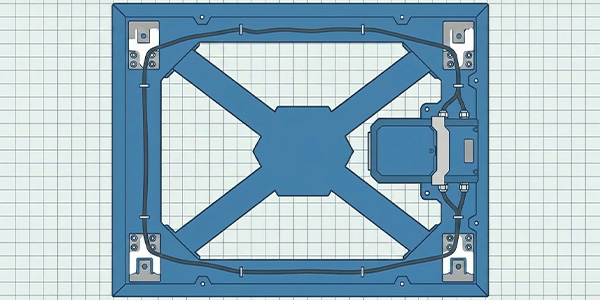
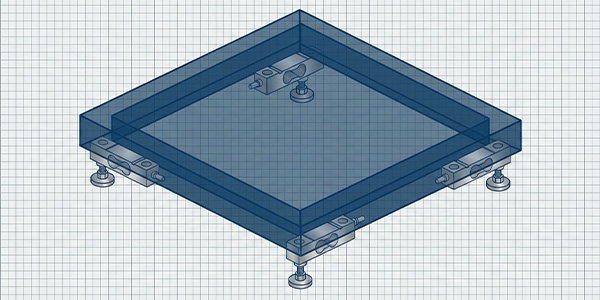
The standard installation uses 4 half-bridge load cells — one at each corner of the litter box base. This configuration provides:
-
Load averaging: Total weight is distributed across 4 sensors, compensating for off-center cat positioning
-
Redundancy: If one sensor drifts, the system still receives valid data from the other three
-
Range multiplication: 4 × 50kg = 200kg total range — far exceeding any realistic litter box load
-
Sensitivity boost: 4 parallel half-bridges double the output signal (single sensitivity × 2)
Wiring Color Code (3-Wire Half-Bridge)
|
Wire Color
|
Function
|
HX711 Pin
|
4-Sensor Connection
|
|
Red
|
Excitation (+)
|
E+
|
All 4 reds → E+
|
|
Black
|
Excitation (−)
|
E−
|
All 4 blacks → E−
|
|
White/Green
|
Signal Output
|
A+ / A−
|
2 whites → A+, 2 whites → A−
|
5-Step Calibration Process
|
Step
|
Action
|
Details
|
|
1
|
Zero calibration (tare)
|
Power on with empty litter box, record ADC baseline value
|
|
2
|
Known weight test
|
Place a 5 kg reference weight at center, record ADC reading
|
|
3
|
Calculate scale factor
|
Scale = 5kg / (ADC_with_weight − ADC_baseline)
|
|
4
|
Off-center verification
|
Move weight to each corner; readings should be within ±2% of center value
|
|
5
|
Firmware upload
|
Write baseline + scale factor to MCU EEPROM; verify with 1 kg and 10 kg test weights
|
How to Choose the Right Load Cell for Your Litter Box
|
Selection Factor
|
Recommended Spec
|
Why It Matters
|
|
Capacity (per sensor)
|
50 kg (×4 = 200 kg total)
|
Covers box + cat + litter + waste with safety margin
|
|
Accuracy
|
±0.05% F.S. (GML670) for health tracking
|
Detects 10-25g weight changes for kitten monitoring
|
|
Thickness
|
≤2.5mm (GML670/GML671)
|
Fits inside slim litter box base without visible protrusion
|
|
Material
|
Manganese Steel
|
Fatigue-resistant for 100k+ cat entry/exit cycles
|
|
Bridge Configuration
|
Half-bridge, 4 pieces/set
|
Cost-effective, off-center compensation, proven in production
|
|
Cable Length
|
450mm (φ0.8mm)
|
Reaches from corners to central PCB with routing margin
|
|
Certifications
|
CE, RoHS, REACH, ISO9001
|
Required for consumer product compliance in EU/US markets
|
Real-World Application Scenarios
|
Scenario
|
How Load Cell Data Is Used
|
User Benefit
|
|
Single-cat health tracking
|
Daily weight log, weekly trend chart, abnormal-change alerts
|
Early detection of weight loss/gain before visible symptoms
|
|
Multi-cat household
|
Weight-based cat identification (each cat's weight is unique)
|
Per-cat usage stats and health profiles without RFID collars
|
|
Senior cat monitoring
|
Track frequency increase (kidney disease) or decrease (constipation)
|
Vet-ready data for geriatric care decisions
|
|
Litter consumption tracking
|
Weight delta = litter consumed; predict refill date
|
Auto-order litter before running out; cost visibility
|
|
Safety lockout
|
Motor disable while weight on platform exceeds threshold
|
Prevents injury if cat re-enters during cleaning cycle
|
|
Vacation mode
|
No weight detected for 24h+ triggers remote alert
|
Pet sitter notification; confirms cat is using the box
|
Smart Pet Care Market Trends
|
Trend
|
Impact on Load Cell Requirements
|
|
Pet humanization
|
Owners treat pets as family — demand health-grade precision (±0.05%) for reliable weight tracking
|
|
AI-powered health analysis
|
Cloud platforms analyze weight + frequency data to predict UTI, diabetes, and kidney issues — requires high-accuracy sensors
|
|
Multi-cat identification
|
Weight-profile fingerprinting needs ±10g resolution — only ±0.05% F.S. sensors qualify
|
|
Subscription litter services
|
Auto-refill requires accurate litter-consumption measurement — load cell becomes a revenue-driving sensor
|
|
Ultra-slim aesthetics
|
Consumers want litter boxes that look like furniture — drives demand for ≤2.5mm thin sensors like GML670
|
|
Veterinary telemedicine
|
Vets request litter box weight logs during remote consults — sensor accuracy directly impacts diagnostic quality
|
Frequently Asked Questions
Q1: Why use 4 load cells instead of 1?
Cats rarely stand in the exact center of a litter box. A single center-mounted sensor would give inaccurate readings when the cat is off-center. Four corner-mounted half-bridge sensors average the load across all four points, providing accurate weight readings regardless of where the cat stands. Additionally, 4 × 50kg = 200kg total range provides ample capacity for any cat-litter combination.
Q2: What is the total range and sensitivity when using 4 half-bridge sensors?
When 4 half-bridge load cells (50kg each) are wired in parallel: Total range = single range × 4 = 200 kg. Total output sensitivity = single sensitivity × 2. For GML670: 0.9 mV/V × 2 = 1.8 mV/V total, which is well within the HX711 ADC's input range.
Q3: Can GML670 detect a small kitten (1.5 kg)?
Yes. With ±0.05% F.S. accuracy on a 50kg sensor, the resolution is ±25g. A 1.5 kg kitten produces a signal far above the noise floor. The HX711 24-bit ADC provides even finer resolution (down to 1g theoretically), so even small weight changes from a kitten eating or drinking are detectable.
Q4: How long do GML670 load cells last in a litter box?
The manganese steel construction is rated for millions of load cycles. In typical smart litter box use (10-15 cat visits per day), the sensors will last well beyond the product's expected lifecycle of 3-5 years. GALOCE conducts fatigue testing to 100,000+ full-scale cycles per batch.
Q5: Which model should I choose for a budget-friendly litter box?
If ±0.2% accuracy is acceptable for your application (basic weight detection without health-grade tracking), GML692 or GML695 offer similar 50kg capacity at a lower cost point. For health monitoring features, GML670 remains the recommended choice with its ±0.05% precision.
Q6: Do you offer OEM/ODM customization?
Yes. GALOCE provides full OEM/ODM services including custom cable lengths, connector types, sensitivity grouping (matched sets for tighter 4-corner accuracy), and private-label packaging. The GML670 supports thickness customization from 1.0mm to 4.0mm to fit specific mechanical designs. Contact our engineering team for customization details.
Build Your Smart Litter Box with GALOCE
GALOCE's GML670 series micro load cells power smart litter boxes from leading pet-tech brands worldwide. With ±0.05% F.S. precision, manganese steel durability, and half-bridge cost optimization, GML670 is the proven choice for health-grade pet monitoring. Request a sample or technical consultation today.