KEY TAKEAWAY
AI checkout scales combine image recognition with precision load cells to automate fresh-food weighing and pricing. GALOCE recommends two parallel-beam load cells for this application: GPB100R (analog mV output, C3 accuracy) for standard integrations and GPB100D (digital RS485/RS232 output, factory-calibrated) for plug-and-play deployments. Both share a compact 130×30×22 mm profile, support up to 250×350 mm platforms, and are validated in real-world retail installations.
AI checkout scales are transforming retail by combining computer vision with precision weighing — but the load cell inside is what makes accurate, per-item pricing possible. This article breaks down how the technology works, what to look for in a load cell, and why GALOCE's GPB100R and GPB100D are the go-to sensors for AI-powered fresh-food checkout.

What Is an AI Checkout Scale?
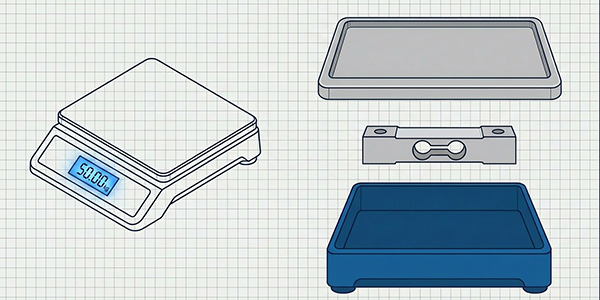
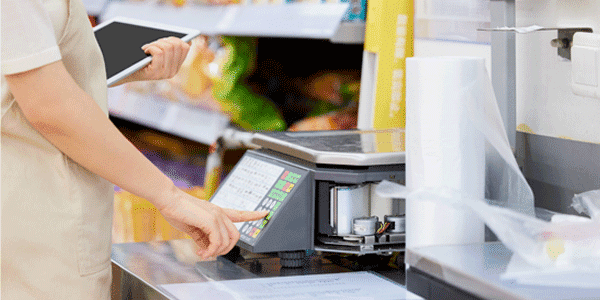
An AI checkout scale is an intelligent weighing terminal that merges artificial intelligence image recognition with high-precision load cell sensing. Instead of requiring a cashier to manually look up a PLU code for each fruit, vegetable, or bulk item, the scale's camera captures an image of the product on the tray, the AI model classifies it in milliseconds, and the load cell simultaneously provides the exact weight — the system then calculates the price automatically.
This technology is widely deployed in supermarkets, fresh-food stores, and self-service kiosks to:
-
Reduce cashier training time and labor costs
-
Eliminate PLU-code lookup errors at checkout
-
Speed up the checkout queue during peak hours
-
Enable 24/7 self-service fresh-food purchasing
-
Provide real-time sales data and inventory insights
At the heart of every AI checkout scale is the load cell — the electromechanical transducer that converts the weight of the produce into a measurable electrical signal. Without an accurate, stable load cell, even the most advanced AI vision system cannot price items correctly.
How an AI Checkout Scale Works: Step by Step
The AI checkout process involves a tightly orchestrated sequence of sensing, recognition, and computation:
|
Step
|
Action
|
Technology Involved
|
|
1
|
Place item on the weighing tray
|
Load cell (GPB100R / GPB100D) senses weight
|
|
2
|
Camera captures product image
|
CMOS camera module + LED illumination
|
|
3
|
AI model classifies the item
|
Deep learning CNN (e.g., ResNet, MobileNet)
|
|
4
|
Load cell signal is processed
|
ADC / HX711 / built-in digital module (GPB100D)
|
|
5
|
System matches item to price database
|
Local database or cloud API lookup
|
|
6
|
Price = weight × unit price
|
MCU computes and displays on screen
|
|
7
|
Print label or send to POS
|
Thermal printer / POS integration
|
The load cell's role is critical: it must deliver a stable, repeatable weight reading within 200–500 ms so the AI recognition and weighing happen in parallel, not sequentially. A slow or noisy load cell directly bottleneck the checkout speed.
Why Parallel Beam (Single-Point) Load Cells Are Ideal for AI Checkout Scales
AI checkout scales almost universally use aluminum alloy parallel beam load cells — also called single-point load cells. Here is why this architecture dominates the category:
|
Advantage
|
Why It Matters for AI Checkout Scales
|
|
Single-sensor design
|
One load cell supports the entire tray — simpler wiring, lower cost, fewer failure points than 4-sensor configurations.
|
|
Off-center load tolerance
|
Customers place items anywhere on the tray; parallel beam geometry maintains accuracy across the full platform.
|
|
Low profile
|
22 mm thickness keeps the overall scale height minimal — important for ergonomic counter integration.
|
|
High accuracy
|
C3 accuracy class (OIML R60) ensures legal-for-trade compliance for retail pricing.
|
|
Aluminum alloy
|
Lightweight, cost-effective, and corrosion-resistant for fresh-food environments with moisture exposure.
|
Types of AI Checkout Scales & Load Cell Requirements
Not all AI checkout scales are the same. Different retail environments call for different configurations:
|
Scale Type
|
Capacity
|
Resolution
|
Recommended Load Cell
|
|
Compact fresh-food scale
|
6–15 kg
|
2 g
|
GPB100R (5 or 10 kg) — analog
|
|
Standard AI checkout scale
|
15–30 kg
|
5 g
|
GPB100R (30 kg) — analog (most common)
|
|
Heavy-duty bulk scale
|
30–60 kg
|
10 g
|
GPB100R (50 or 60 kg) — analog
|
|
Plug-and-play smart scale
|
15–30 kg
|
5 g
|
GPB100D (30 kg) — digital RS485/RS232
|
|
Self-service kiosk
|
30 kg
|
5 g
|
GPB100D (30 kg) — digital (factory-calibrated)
|
The most popular configuration is 30 kg capacity with 5 g resolution, using a single GPB100R or GPB100D load cell — exactly what the original article highlights.
Recommended Load Cells: GPB100R & GPB100D
GALOCE offers two variants of the same proven parallel-beam platform — one analog, one digital — giving AI checkout scale manufacturers flexibility depending on their system architecture:
GPB100R — Analog Parallel Beam Load Cell (mV Output)
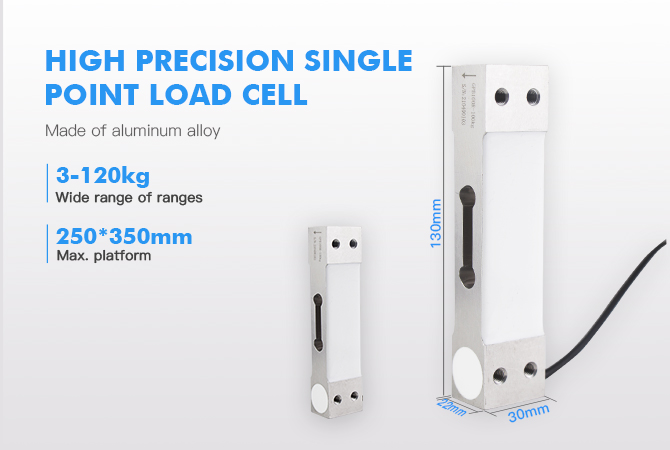
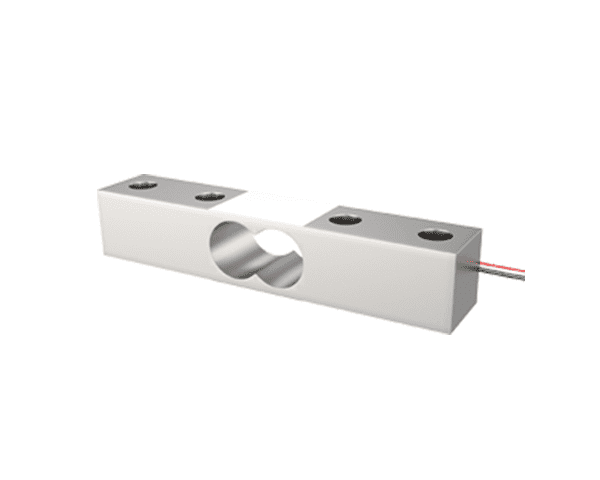
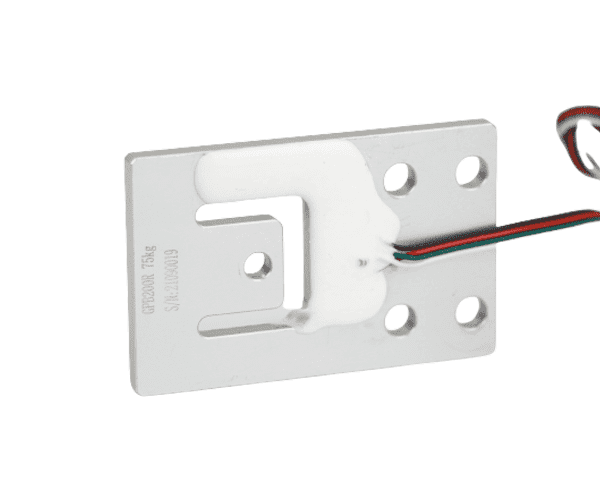
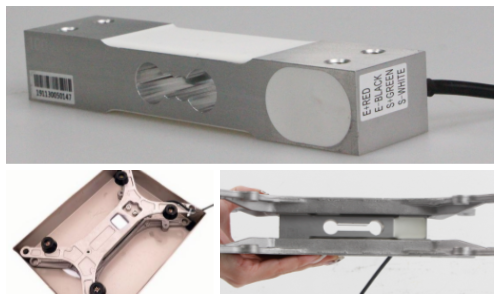
The GPB100R is a high-performance single-point load cell engineered with a parallel beam structure for exceptional off-center load resistance. Crafted from anodized aluminum alloy (2A12), it delivers stable C3 accuracy and is the industry-standard choice for AI checkout scales requiring traditional analog signal conditioning.
|
GPB100R Technical Specifications
|
|
Capacity Range
|
3, 5, 8, 10, 15, 20, 30, 40, 50, 60, 80, 100 kg
|
|
Accuracy Class
|
C3 (OIML R60)
|
|
Sensitivity
|
2.0 ± 0.2 mV/V
|
|
Combined Error
|
±0.02% F.S
|
|
Creep (30 min)
|
±0.02% F.S
|
|
Material
|
Aluminum alloy (2A12), anodized
|
|
Dimensions
|
130 × 30 × 22 mm
|
|
Max Platform Size
|
250 × 350 mm (single-sensor)
|
|
Protection Rating
|
IP65
|
|
Input / Output Resistance
|
350 ± 3.5 Ω / 350 ± 3.5 Ω
|
|
Operating Temperature
|
-10 °C ~ +40 °C
|
|
Cable
|
PVC shielded, 4-core, φ4.0 × 400 mm (customizable)
|
|
Certifications
|
ISO9001, CE, RoHS
|
|
Output Signal
|
Analog mV/V (requires external ADC)
|
GPB100R — Featured Highlights
-
Classic 130×30×22 mm footprint — drop-in compatible with most AI checkout scale chassis
-
C3 accuracy class — meets legal-for-trade requirements for retail pricing
-
Factory-adjusted four-corner error — ready for single-sensor installation up to 250×350 mm
-
IP65 sealed — silicone gel sealing withstands humid fresh-food environments
-
OEM & ODM customizable — cable length, connectors, and capacity on request
-
Proven in production — deployed in thousands of AI checkout scales worldwide
Learn more: GPB100R Product Page
GPB100D — Digital Parallel Beam Load Cell (RS485/RS232 Output)
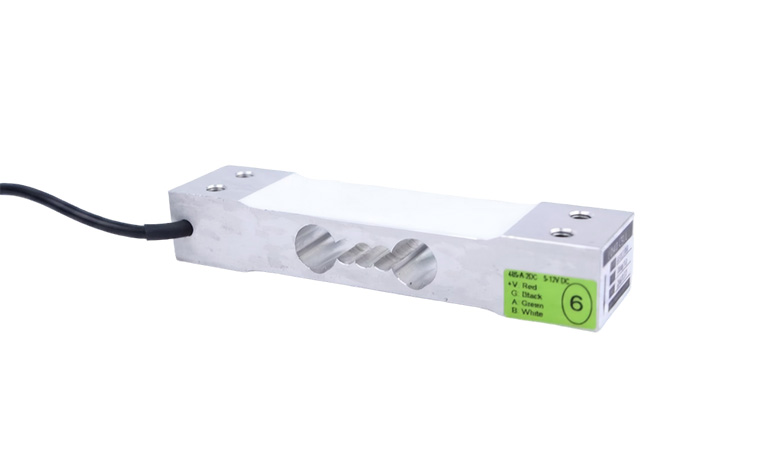
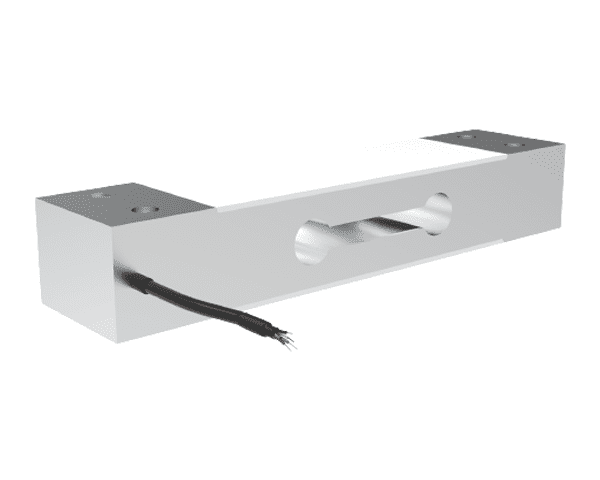
The GPB100D shares the same mechanical platform as the GPB100R but adds a built-in digital signal module that outputs weight data directly via RS485 or RS232. This eliminates the need for an external ADC, simplifies system integration, and enables true plug-and-play deployment.
|
GPB100D Technical Specifications
|
|
Material
|
Aluminum alloy, surface anodized & anticorrosion
|
|
Output Signal
|
Digital — RS485 or RS232
|
|
Max Platform Size
|
250 × 350 mm
|
|
Calibration
|
Factory-calibrated — no field calibration required
|
|
Gravity Compensation
|
Built-in — deploy at any location without recalibration
|
|
Division Value
|
Software-configurable — change resolution without field calibration
|
|
Commands
|
Zero-setting & weight read — immediately accessible
|
|
Typical Applications
|
AI checkout scales, smart shelves, smart gravity cabinets, garbage recycling
|
GPB100D — Featured Highlights
-
Plug-and-play digital output — RS485/RS232, no external ADC needed
-
Factory-calibrated — zero commissioning time, ideal for mass deployment
-
Gravity compensation — ships to any city/altitude without recalibration
-
On-the-fly resolution change — switch division value via command, no weights needed
-
Simplified wiring — fewer components, lower total system cost
-
Best for self-service kiosks — minimal maintenance, maximum uptime
Learn more: GPB100D Product Page
GPB100R vs GPB100D: Which One Should You Choose?
Both sensors share identical mechanical dimensions and load capacities. The key difference is in the signal output and integration complexity:
|
Parameter
|
GPB100R (Analog)
|
GPB100D (Digital)
|
|
Output Signal
|
mV/V (analog)
|
RS485 / RS232 (digital)
|
|
External Components
|
Requires ADC (e.g., HX711, ADS1230)
|
No ADC needed — direct MCU connection
|
|
Calibration
|
Field calibration required at deployment site
|
Factory-calibrated, gravity-compensated
|
|
Noise Immunity
|
Susceptible to EMI on long cable runs
|
Digital bus — inherently noise-resistant
|
|
Unit Cost
|
Lower (sensor only)
|
Slightly higher (built-in module)
|
|
Total System Cost
|
Sensor + ADC + calibration labor
|
Sensor only — often lower TCO
|
|
Best For
|
Established designs with existing ADC circuitry
|
New designs, self-service kiosks, rapid deployment
|
Rule of thumb: If your AI checkout scale already has a proven analog front-end (ADC + signal conditioning), the GPB100R integrates seamlessly. If you are designing a new platform or deploying self-service kiosks across multiple locations, the GPB100D's factory calibration and gravity compensation save significant commissioning time and cost.
Load Cell Selection Criteria for AI Checkout Scales
When choosing a load cell for your AI checkout scale, evaluate these six critical factors:
|
Factor
|
GPB100R / GPB100D Spec
|
Why It Matters
|
|
Capacity
|
3–100 kg (12 options)
|
30 kg covers 95% of fresh-food items; larger capacity for bulk goods
|
|
Accuracy
|
C3 (OIML R60), ±0.02% F.S
|
Legal-for-trade certification required for retail pricing
|
|
Platform Size
|
Up to 250×350 mm
|
Sufficient for standard fresh-food trays; single-sensor keeps cost low
|
|
Environmental Protection
|
IP65
|
Fresh-food areas have humidity, splashes, and frequent cleaning
|
|
Temperature Range
|
-10 °C ~ +40 °C
|
Covers refrigerated display areas and ambient store conditions
|
|
Response Speed
|
< 200 ms settling
|
Must keep pace with AI image recognition for instant checkout
|
Installation & Wiring Guide
Mechanical Installation
-
Fixed end: Bolt the sensor's fixed side to the scale base using 2× M6 screws through the mounting holes. Apply thread-locking adhesive.
-
Loading end: Attach the weighing tray to the loading side using 2× M6 screws. Ensure the tray is level and centered.
-
Platform dimensions: Keep within 250×350 mm for single-sensor installation to maintain off-center load accuracy.
-
Clearance: Maintain a 0.5–1.0 mm gap between the tray and the scale housing to prevent mechanical interference.
-
Overload protection: Install a mechanical stop at 120% of rated capacity to protect the sensor from damage.
-
Cable routing: Route the cable through a strain-relief grommet; avoid sharp bends and keep away from AC power lines.
Wiring (GPB100R — 4-Wire Analog)
|
Wire Color
|
Function
|
Connects To
|
|
Red
|
Excitation (+)
|
ADC E+ (e.g., HX711 E+)
|
|
Black
|
Excitation (-)
|
ADC E- (e.g., HX711 E-)
|
|
Green
|
Signal (+)
|
ADC A+ (e.g., HX711 A+)
|
|
White
|
Signal (-)
|
ADC A- (e.g., HX711 A-)
|
|
Shield
|
Ground
|
Scale chassis ground
|
Wiring (GPB100D — Digital RS485)
|
Wire
|
Function
|
Connects To
|
|
A (DATA+)
|
RS485 differential positive
|
MCU UART-RX (via RS485 transceiver)
|
|
B (DATA-)
|
RS485 differential negative
|
MCU UART-RX (via RS485 transceiver)
|
|
VCC
|
Power supply (5–12 V DC)
|
Regulated DC power
|
|
GND
|
Ground
|
Common ground
|
5-Step Calibration (GPB100R)
For the GPB100D, factory calibration covers all steps below — skip to step 5 (verification). For the GPB100R, follow the full procedure:
-
Step 1 — Zero calibration: Power on with an empty tray. Record the ADC zero-point reading.
-
Step 2 — Span calibration: Place a certified test weight (e.g., 10 kg, traceable) at the center of the tray. Record the ADC span reading.
-
Step 3 — Four-corner check: Place the same weight at each corner of the 250×350 mm tray. Corner error should be ≤ 1 division (5 g for 30 kg / 6000 d).
-
Step 4 — Linearity verification: Test at 25%, 50%, 75%, and 100% of capacity. Linearity error should be ≤ 0.02% F.S.
-
Step 5 — AI integration test: Place 5 different fresh-food items on the scale. Verify that AI recognition + weight reading completes within 1 second total, and the printed price matches manual calculation.
Real-World Application: AI Fresh-Food Checkout
GALOCE's parallel beam load cells are deployed in AI checkout scales across major supermarket chains. A typical installation involves:
|
Parameter
|
Value
|
|
Scale Type
|
Countertop AI fresh-food checkout scale
|
|
Load Cell
|
GPB100R, 30 kg capacity, single installation
|
|
Resolution
|
5 g (6000 display divisions)
|
|
AI Recognition Time
|
~300 ms per item
|
|
Total Checkout Time
|
< 1 second (recognition + weighing + pricing)
|
|
Recognition Accuracy
|
> 99% for top 200 SKUs
|
|
Deployment Scale
|
Thousands of units across multiple retail chains
|
The result: 40–60% faster checkout compared to manual PLU-code entry, with near-zero pricing errors and significantly reduced cashier training requirements.
Market Trends: The Future of AI Checkout Weighing
-
Edge AI adoption: On-device inference chips (NPU) eliminate cloud latency, enabling sub-200 ms recognition even in stores with poor connectivity.
-
Multi-item recognition: Next-generation AI scales recognize multiple items placed on the tray simultaneously — the load cell must handle combined weight while the vision system separates each item.
-
Self-service expansion: Post-pandemic labor shortages are accelerating deployment of unattended fresh-food kiosks, driving demand for factory-calibrated sensors like the GPB100D.
-
Cloud-based price management: IoT-connected scales push real-time weight and sales data to cloud dashboards for dynamic pricing and inventory management.
-
Slimmer profiles: Retailers want scales that blend into the countertop — driving demand for ultra-thin load cells without compromising accuracy.
-
Legal-for-trade digital sensors: Regulatory bodies are increasingly approving digital-output load cells for trade use, accelerating GPB100D adoption.
Frequently Asked Questions
Q1: What capacity load cell do I need for an AI checkout scale?
For standard fresh-food checkout (fruits, vegetables, meat, seafood), 30 kg capacity with 5 g resolution is the industry standard. For compact scales handling only small items, 6–15 kg may suffice. For bulk goods, consider 50–60 kg. The GPB100R and GPB100D both offer capacities from 3 to 100 kg.
Q2: Should I choose GPB100R (analog) or GPB100D (digital)?
Choose GPB100R if your system already has an ADC front-end and you need the lowest sensor unit cost. Choose GPB100D if you are designing a new platform, deploying across multiple locations (factory calibration + gravity compensation eliminate field calibration), or want to minimize total component count.
Q3: Can one load cell really support the entire weighing tray?
Yes. The GPB100R/GPB100D are single-point load cells, engineered with a parallel beam structure that compensates for off-center loads. A single sensor can accurately weigh items placed anywhere on a platform up to 250×350 mm — no need for four-sensor configurations.
Q4: How fast does the load cell need to respond?
The load cell should deliver a stable reading within 200 ms of item placement. This allows the AI vision system and weighing to run in parallel, achieving a total checkout time of under 1 second. Both GPB100R and GPB100D meet this requirement.
Q5: Is IP65 protection necessary for fresh-food environments?
Yes. Fresh-food areas involve humidity, water splashes during cleaning, and potential condensation in refrigerated zones. IP65 (dust-tight, water-jet resistant) ensures the load cell maintains accuracy and longevity in these conditions.
Q6: Can I customize the cable length or connector?
Yes. GALOCE offers OEM and ODM customization for cable length (standard 400 mm, customizable), connector type, capacity range, and even private-label packaging. Contact our engineering team to discuss your requirements.
Build Your AI Checkout Scale with GALOCE
Get samples, technical drawings, and engineering support for GPB100R or GPB100D — validated in thousands of retail deployments worldwide.
View GPB100R View GPB100D
The AI checkout scale saves energy and increases efficiency. GALOCE is committed to bridging the gap from idea to reality, providing accurate and effective weighing solutions for various industries. If you have any idea related to weighing, feel free to contact us — we will do our best to satisfy you.