





Published on: | Author: Galoce Industrial Sensing Team
Choosing between an S-type load cell and a spoke type load cell can be confusing—both are versatile, both measure force, but they excel in fundamentally different applications. The S-type (or S-beam) is the go-to for in-line tension and compression measurements, while the spoke type (or pancake) dominates in low-profile compression applications with high side-load resistance [citation:2][citation:3]. This comprehensive guide breaks down their design differences, performance characteristics, ideal applications, and helps you make the right choice for your specific weighing or force measurement needs.
1. Quick Overview: At a Glance Comparison
Before diving into details, here's a high-level summary of the key differences between S-type and spoke type load cells [citation:1][citation:2][citation:3]:
| Feature | S-Type Load Cell | Spoke Type Load Cell |
|---|---|---|
| Shape / Profile | S-shaped body, tall and narrow [citation:1] | Pancake or wheel-spoke shape, low profile [citation:1][citation:4] |
| Force Measurement | Both tension and compression (bidirectional) [citation:2][citation:5] | Primarily compression; some models can measure tension [citation:4][citation:9] |
| Mounting | In-line with threaded connections (rod ends, clevises) [citation:2] | Flat mounting under the load (bolted to base) [citation:3][citation:6] |
| Typical Capacity Range | 10 grams to 20,000+ lb (up to 10 tons) [citation:2][citation:5][citation:8] | 50 kg to 80+ tons [citation:6][citation:9] |
| Side Load / Eccentric Load Resistance | Low—requires precise axial alignment [citation:2] | Excellent—inherent design compensates for off-axis forces [citation:1][citation:3] |
| Best Applications | Hanging scales, suspended hoppers, test machines, tension monitoring [citation:2][citation:8] | Platform scales, tank/silo weighing, truck scales, industrial presses [citation:3][citation:6] |
| Installation Height | Tall (varies with capacity) | Very low [citation:1] |
2. What Is an S-Type Load Cell?
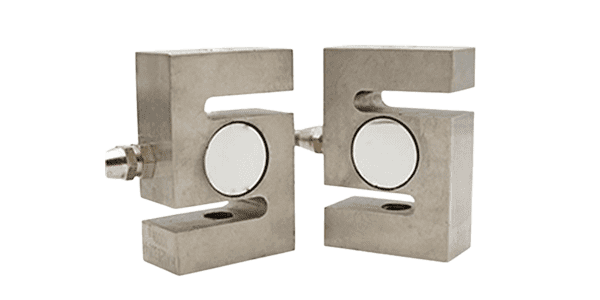
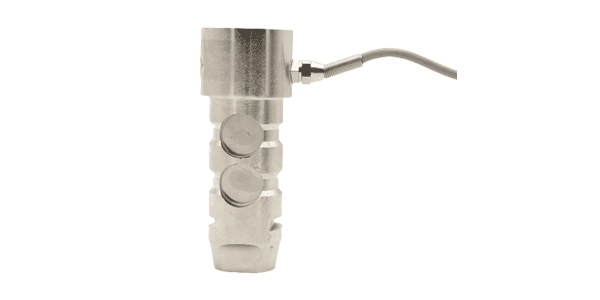
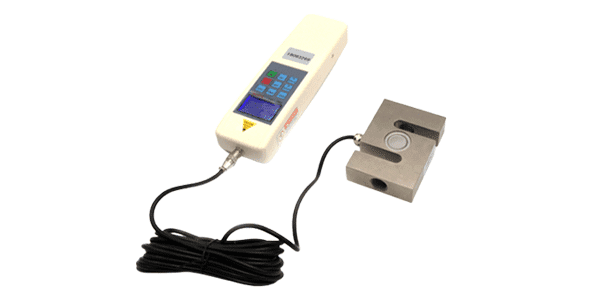
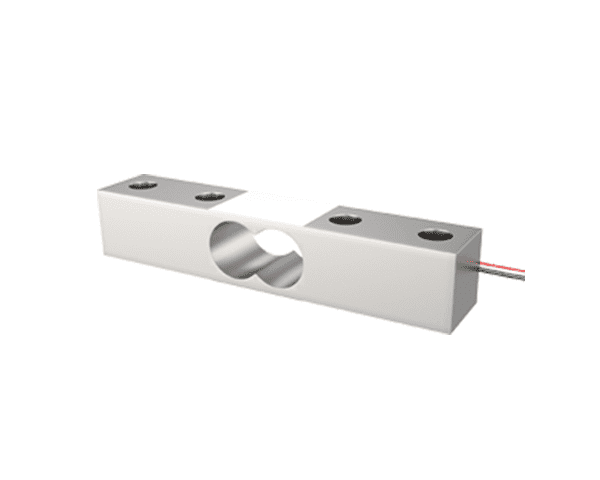
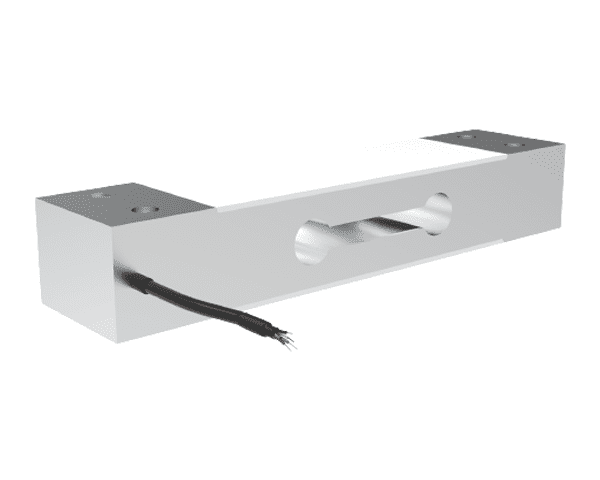
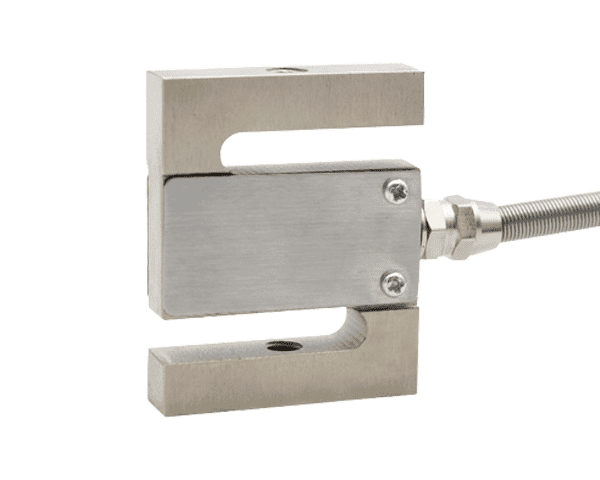
An S-type load cell (also called S-beam, Z-beam, or tension-compression load cell) is named for its distinctive S-shaped body [citation:1][citation:2]. It features threaded holes on both ends, allowing it to be inserted directly into a force path using rod ends, clevises, shackles, or eye bolts [citation:2][citation:5].
How It Works
The S-shaped body creates a defined bending zone in the center web. Strain gauges bonded to this web detect deformation when force is applied. In tension, the web stretches on one side and compresses on the other; in compression, the pattern reverses. The Wheatstone bridge configuration produces a positive output for tension and negative for compression, allowing signed value display [citation:2].
Typical Applications [citation:2][citation:5][citation:8]
- Crane and hanging scales: Suspended between hook and load
- Suspended hopper and bin weighing: Replacing tension links in suspension systems
- Material testing machines: Tensile and compression testing
- Cable, chain, and wire tension monitoring
- In-line force verification in assembly operations
- Tank weighing (suspended tanks) [citation:8]
3. What Is a Spoke Type Load Cell?
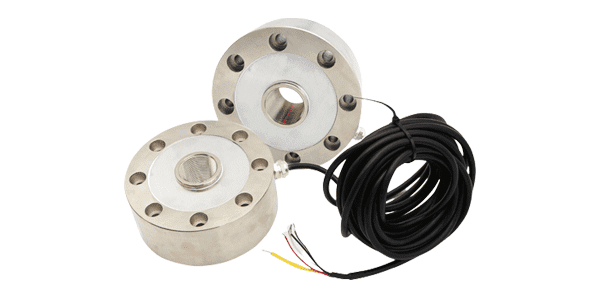
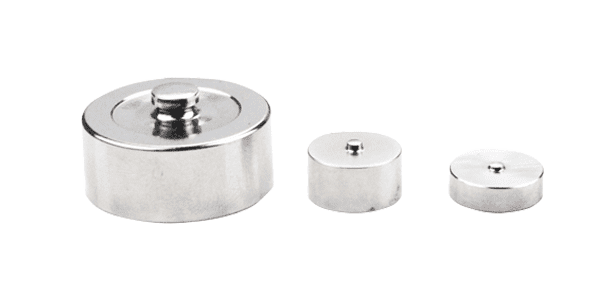
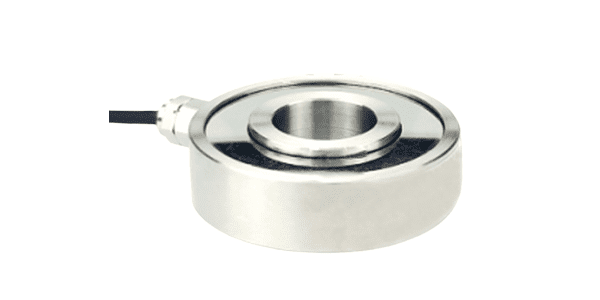
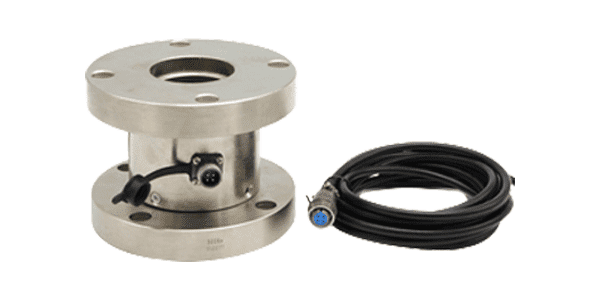
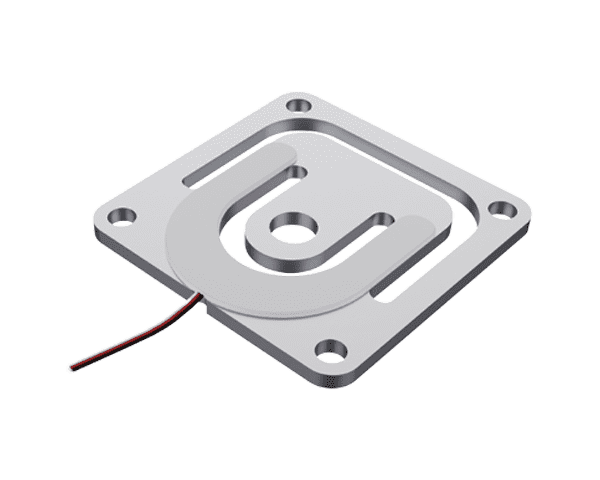
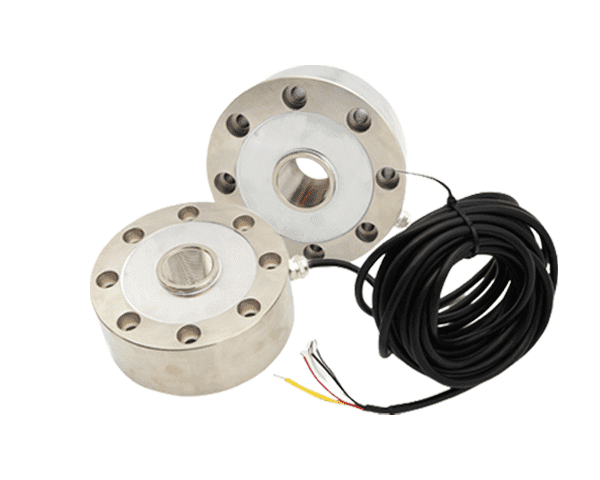
A spoke type load cell (also called wheel-spoke, pancake, or low-profile load cell) features a design resembling a wheel with spokes radiating from a central hub to an outer ring [citation:1][citation:4]. The load is transferred through these spokes, and the sensor measures shear stress—hence the name "spoke-type shear force load cell" [citation:1].
How It Works
When force is applied to the central hub (in compression) or through the threaded center hole (in tension), the spokes undergo controlled shear deformation. Strain gauges bonded to the spokes detect this strain, producing an output proportional to the applied force [citation:1][citation:3].
Typical Applications [citation:3][citation:6][citation:7]
- Platform scales and floor scales
- Tank, hopper, and silo weighing (supported from below) [citation:3]
- Truck scales and weighbridges [citation:6]
- Industrial presses and force monitoring
- Forklift scales and pallet trucks [citation:7]
- Medical beds and dynamic weighing applications
Spoke type load cells are also available in versions that can measure tension using a threaded center hole, but their primary strength is in compression applications [citation:4][citation:9].
4. Head-to-Head Comparison
Now let's examine the key differences in detail to help you make an informed decision.
| Parameter | S-Type Load Cell | Spoke Type Load Cell |
|---|---|---|
| Design Principle | S-shaped beam with central bending zone [citation:2] | Wheel-spoke geometry measuring shear stress [citation:1] |
| Force Measurement | True bidirectional (tension and compression) [citation:2] | Primarily compression; tension possible with center thread [citation:4] |
| Mounting Style | In-line with threaded connections [citation:2] | Flat mounting under the load [citation:3] |
| Physical Profile | Tall and narrow [citation:1] | Low profile, compact height [citation:1] |
| Capacity Range | 10 g to 10 t (typical) [citation:5][citation:8] | 50 kg to 80 t (typical) [citation:6][citation:9] |
| Side Load Tolerance | Low—requires axial alignment [citation:2] | Excellent—inherent design compensates [citation:1][citation:3] |
| Eccentric Load Handling | Poor—must be centered | Excellent—natural compensation [citation:1] |
| Typical Accuracy | ±0.02% to ±0.03% F.S. [citation:2] | ±0.03% to ±0.05% F.S. (higher precision models available) [citation:3][citation:6] |
| Overload Capacity | 150% safe, 300% ultimate [citation:2] | 150–250% safe (model dependent) [citation:6] |
| Material Options | Alloy steel (nickel-plated), stainless steel [citation:2][citation:5] | Alloy steel, stainless steel [citation:6][citation:9] |
| Sealing / IP Rating | IP65 to IP67 typical [citation:2][citation:8] | IP65 to IP68 available [citation:3][citation:6] |
5. Force Direction: Tension vs. Compression
This is perhaps the most fundamental difference between the two types [citation:1][citation:2].
✅ S-Type: True Bidirectional
- Measures both tension and compression in a single sensor [citation:2][citation:5]
- Output polarity changes (positive for tension, negative for compression) [citation:2]
- Ideal for applications requiring both push and pull measurements
- Perfect for test machines, suspended scales, and in-line force monitoring
⚠️ Spoke Type: Primarily Compression
- Designed primarily for compression (load applied to center) [citation:3][citation:4]
- Some models can measure tension via center thread [citation:4][citation:9]
- Best for applications where load sits on top of the sensor
- Platform scales, tank weighing, industrial presses [citation:3][citation:6]
6. Capacity Ranges: Which One Handles Heavier Loads?
Both types cover a wide range, but they have different sweet spots [citation:1][citation:2][citation:9].
| Load Cell Type | Typical Capacity Range | Best Suited For |
|---|---|---|
| S-Type | 10 grams – 10,000 kg (22,000 lb) [citation:2][citation:5][citation:8] |
|
| Spoke Type | 50 kg – 80 tons (and higher) [citation:6][citation:9] |
|
According to one manufacturer, the capacity of S-type load cells is actually larger than spoke type in some comparisons [citation:1], but this likely refers to specific model lines. In practice, both types overlap significantly in the 1–10 ton range, with spoke types extending to much higher capacities (80+ tons) for heavy industrial use [citation:9].
- Under 1 ton: Both types work well; choose based on mounting needs
- 1–10 tons: Significant overlap; let application dictate choice
- 10–80+ tons: Spoke type is generally better suited [citation:6][citation:9]
7. Physical Profile and Installation
The physical shape of these load cells dictates where and how they can be installed [citation:1][citation:2].
S-Type: Tall and Narrow
- Tall profile with threaded ends [citation:1]
- Requires vertical space for installation
- Mounts in-line with the force path using rod ends, clevises, or shackles [citation:2]
- Easy to retrofit into existing linkages [citation:2]
- Must be centered in the load path [citation:2]
Spoke Type: Low and Wide
- Flat, pancake-like profile with minimal height [citation:1][citation:4]
- Ideal for space-constrained installations [citation:3]
- Mounts directly under the load (bolted to base) [citation:3][citation:6]
- Multiple bolt holes for secure mounting [citation:6]
- Requires flat, rigid mounting surface [citation:3]
8. Side Load and Eccentric Load Resistance
This is where the two types diverge dramatically [citation:1][citation:2][citation:3].
⚠️ S-Type: Low Tolerance
- Very sensitive to off-axis forces [citation:2]
- Side loads or bending moments cause significant errors
- Requires precise alignment and articulation (rod ends, clevises) [citation:2]
- Not suitable for applications with unavoidable side forces
✅ Spoke Type: Excellent Tolerance
- Inherent design compensates for side loads and eccentric loading [citation:1][citation:3]
- Multi-spoke geometry naturally resists lateral forces [citation:3]
- Ideal for platform scales where loads aren't perfectly centered [citation:7]
- Maintains accuracy even with uneven loading [citation:1]
This difference stems from the fundamental design: S-type cells concentrate stress in a central web that's easily influenced by off-axis forces, while spoke type cells distribute forces across multiple radial beams that cancel out side loads [citation:1][citation:3].
9. Accuracy and Performance
Both types can achieve excellent accuracy, but the specifications differ slightly [citation:1][citation:2][citation:6].
| Parameter | S-Type Load Cell | Spoke Type Load Cell |
|---|---|---|
| Combined Error (Non-linearity + Hysteresis) | ≤ ±0.02% to ±0.03% F.S. [citation:2] | ±0.03% to ±0.05% F.S. typical [citation:3][citation:6] |
| Repeatability | ≤ ±0.01% F.S. [citation:2] | Excellent (specifics vary by model) |
| Creep (30 min) | Model dependent, typically ±0.03% | Low due to robust design [citation:1] |
| High-Precision Models | Available for critical applications | Pro models achieve ±0.035% to ±0.1% F.S. [citation:6][citation:9] |
According to one comparison, the accuracy of S-type cells may be slightly higher [citation:1], but the difference is minimal for most industrial applications. Both can meet C3 (0.02%) or higher standards required for legal-for-trade applications [citation:2][citation:8].
10. Environmental Considerations
Both types are available in configurations for harsh environments, but there are differences in standard offerings [citation:2][citation:3][citation:6].
Material Options
- S-Type: Nickel-plated alloy steel (standard), stainless steel options available [citation:2][citation:5]
- Spoke Type: Alloy steel (standard), stainless steel for corrosive environments [citation:6][citation:9]
Environmental Sealing (IP Ratings)
- S-Type: IP65 to IP67 typical [citation:2][citation:8]
- Spoke Type: IP65 to IP68 available; some models designed for harsh industrial use [citation:3][citation:6]
Specialized Versions
- S-Type: Hazardous area approvals (ATEX, FM) available [citation:8]
- Spoke Type: Explosion-proof versions for hazardous environments [citation:3]
11. Cost Factors
Pricing depends on capacity, material, accuracy, and certifications, but general trends exist [citation:1].
- S-Type: Generally more cost-effective for lower capacities and general-purpose tension/compression applications. Widely available with many manufacturers offering competitive pricing [citation:1][citation:2].
- Spoke Type: The complex machining of the spoke geometry can increase manufacturing cost [citation:1]. However, for high-capacity compression applications, they offer excellent value.
For equivalent capacity and accuracy, spoke type cells may carry a slight premium due to their more complex machining requirements [citation:1]. However, the price difference is usually justified by their superior side-load resistance and low-profile design.
12. Decision Guide: Which One Should You Choose?
Use this decision framework to select the right load cell for your application [citation:2][citation:3][citation:10].
🔍 Step-by-Step Selection
Start here:
- Does your application require measuring BOTH tension and compression forces? → Choose S-Type [citation:2]
- Is the load primarily compression (sitting on top of the sensor)? → Consider both types, then ask:
- Is installation height limited? → Spoke type (low profile) [citation:1][citation:3]
- Will the load be perfectly centered with no side forces? → Either type works; S-type may be more cost-effective for lower capacities [citation:1]
- Are side loads or off-center loading expected? → Spoke type (excellent tolerance) [citation:1][citation:3]
- Is this a platform scale, tank, or silo? → Spoke type [citation:3][citation:6]
- Is the load suspended or hanging? → S-Type [citation:2][citation:8]
- Is this for in-line force monitoring (test machines, cable tension)? → S-Type [citation:2][citation:5]
- Is this for very high capacity (over 20 tons)? → Spoke type excels in heavy capacities [citation:6][citation:9]
Quick Reference by Application
| Application | Recommended Type | Reason |
|---|---|---|
| Crane scales / hanging scales | S-Type | In-line tension measurement with threaded connections [citation:2][citation:5] |
| Suspended hoppers / bins | S-Type | Replaces tension links in suspension systems [citation:2][citation:8] |
| Platform scales / floor scales | Spoke Type | Low profile, handles off-center loads [citation:3][citation:7] |
| Tank / silo weighing (supported) | Spoke Type | Compression mounting, side load resistance [citation |