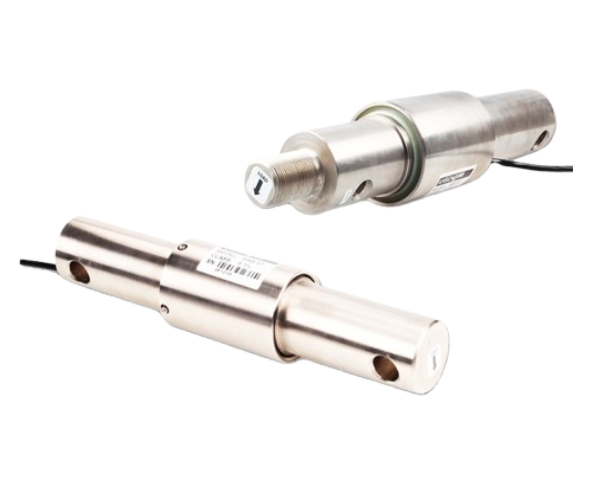
Mastering Load Cell Sensitivity: The Definitive Technical Guide
In the landscape of precision weighing, the mV/V rating is the most critical specification on a datasheet. In this 2000-word handbook, you will master the entire spectrum of load cell sensitivity—from foundational definitions and ratiometric logic to complex troubleshooting and multi-cell matching. We have restored every original technical insight to ensure you possess the clarity required to optimize your weighing system's accuracy and noise immunity.
📋 In This Comprehensive Guide:
1. What is Load Cell Sensitivity (mV/V)?
Load cell sensitivity—also called rated output (RO)—is a measure of how much electrical signal the load cell produces in response to an applied force. It defines the relationship between the mechanical input (load) and the electrical output (voltage) [citation:1][citation:2]. In technical terms, sensitivity tells you: "For every volt of excitation supplied to the load cell, how many millivolts of output will I get when the cell is loaded to its full capacity?" [citation:4]
🔍 Simple Analogy: Think of sensitivity like the volume knob on a radio. A higher sensitivity (like turning up the volume) means the load cell "speaks louder"—producing a stronger signal for the same amount of force. This makes it easier for your indicator or PLC to resolve small changes in weight.
2. The Unit Explained: Why "mV/V"?
The unit mV/V (millivolts per volt) is a ratiometric measurement. This is a deliberate design choice with two major benefits: Voltage Independence (sensitivity rating is independent of whether you use 5V or 10V excitation) and a Universal Standard for engineers to compare different sensors on a consistent scale [citation:2][citation:4].
⚡ The Golden Formula:
Output Signal (mV) = Sensitivity (mV/V) × Excitation Voltage (V) × (Applied Load ÷ Rated Capacity)
3. Typical Sensitivity Values: The 2 mV/V Standard
While 2.0 mV/V is the industry standard for most industrial load cells, sensitivity varies across specialized applications:
4. How to Calculate Output Signal from mV/V
Calculating the actual millivolt output for any given load is straightforward. Use this step-by-step logic:
Example Case: 2.0 mV/V Sensitivity | 1000kg Capacity | 10VDC Excitation | 500kg Load
Step 1: Calculate Load Ratio = 500 kg ÷ 1000 kg = 0.5
Step 2: Calculate Output per Volt = 2.0 mV/V × 0.5 = 1.0 mV/V
Step 3: Final mV = 1.0 mV/V × 10 V = 10.0 mV
5. Why Sensitivity Matters: 7 Key Reasons
-
Accuracy & Detection: Higher sensitivity produces a larger signal for small weight shifts.
-
Signal-to-Noise Ratio (SNR): A stronger signal is less affected by industrial EMI/RFI noise.
-
Electronics Compatibility: mV/V must match the input range of your indicator or PLC.
-
Calibration Foundation: Ratiometric consistency is the math behind all span calibrations.
-
System Troubleshooting: Expected vs. measured mV output helps identify wiring issues.
-
Multi-Cell Balance: Platform scales require matched sensitivity to avoid corner errors.
-
Voltage Flexibility: Allows scaling the output signal by adjusting excitation.
6. High Sensitivity vs. Low Sensitivity Trade-offs
There is no "best" sensitivity—only the right one for your environment. High sensitivity (3-4 mV/V) offers superior noise immunity but can be more fragile. Low sensitivity (1-2 mV/V) is often more robust and capable of surviving extreme overloads in truck scale or silo environments [citation:1][citation:4].
7. Sensitivity vs. Accuracy vs. Resolution
While often confused, these terms represent different performance metrics. Sensitivity is signal strength; Accuracy is the closeness to true weight (incorporating non-linearity); and Resolution is the smallest detectable increment [citation:3][citation:8]. High sensitivity enables better resolution but does not guarantee accuracy if calibration or design quality is poor.
8. Factors That Affect Sensitivity and Output Stability
Sensitivity is not an immovable constant. You must account for these environmental variables that can distort effective output [citation:3][citation:9]:
-
Temperature Fluctuations: Causes thermal expansion of the spring element. High-quality GALOCE sensors include internal temperature compensation circuitry.
-
Mechanical Side-Loading: Forces not aligned with the measurement axis distort the strain field, reducing effective sensitivity.
-
Cable Resistance: Long cable runs cause a voltage drop. Use 6-wire systems with "sense" lines to maintain ratiometric integrity over distance.
-
Aging and Fatigue: Over years of heavy cycles, strain gauge bonding can experience minute shifts, requiring annual Span Calibration [citation:8].
9. Matching Sensitivity in Multi-Cell Systems
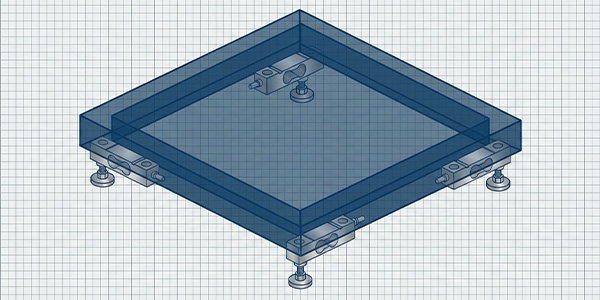
In platform scales or weighbridges, matched sensitivity (e.g., all cells at 2.0 mV/V ± 0.1%) is non-negotiable. If sensitivities vary, placing the same load over different corners will output different signals, causing a "corner error" and rendering your total weight reading inaccurate [citation:10].
10. Conclusion & Selection Recommendations
Sensitivity (mV/V) is the "gain" of your measurement system. For general industrial use, 2.0 mV/V is the safe, robust, and widely compatible choice. For laboratory or high-fidelity testing, consider 3.0 mV/V or higher. Always ensure your instrumentation matches the output range to maximize SNR and accuracy.
Technical FAQ: Load Cell Sensitivity
1. Can I use a 2 mV/V and a 3 mV/V load cell in the same system?
No. Mixing sensitivities in a multi-cell system (like a platform or tank scale) will cause severe corner errors. The indicator will not be able to sum the weights accurately. Always use matched sets.
2. Does a higher mV/V rating mean a "better" sensor?
Not necessarily. High sensitivity offers better resolution for small loads, but 2.0 mV/V sensors are often more physically robust and better suited for heavy industrial impacts. Choice depends on your application.
3. How does excitation voltage affect the sensitivity?
It doesn't affect the rating (mV/V is constant), but it affects the actual mV output. Doubling the excitation (e.g., from 5V to 10V) will double the output signal strength, improving SNR.
4. Why do long cables reduce effective sensitivity?
Resistance in long wires causes a voltage drop. This means the actual voltage reaching the Wheatstone bridge is lower than the supply, proportionally reducing the mV output. Use 6-wire sensing to fix this.
5. Can sensitivity drift over time?
Yes. Mechanical fatigue and moisture can cause "Span Drift." We recommend annual calibration to correct the effective sensitivity and ensure ongoing precision.
Ready to Elevate Your Measurement Standards?
Selection is as critical as installation. Whether you need C3 precision, extreme IP protection, or custom capacity sensors, GALOCE technical engineers are here to support your global requirements.